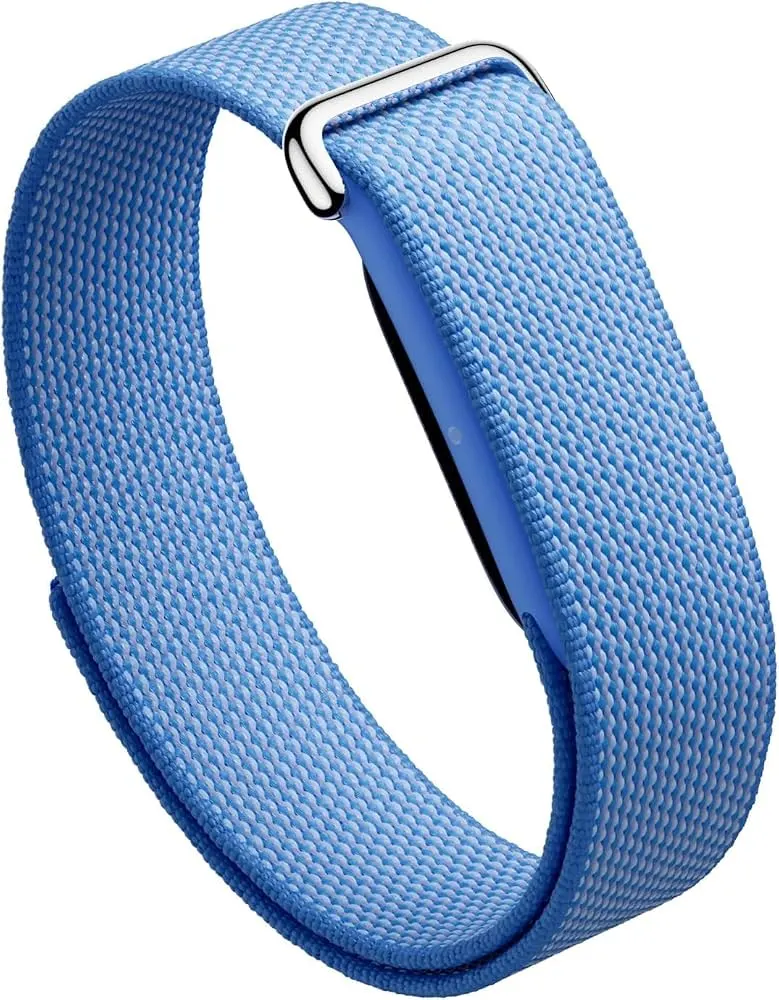
Luna Band vs Google Fitbit Air, side by side
| Feature | Luna Band | Google Fitbit Air |
|---|---|---|
| Display and alerts | No display; alerts, nudges and alarms by haptic vibration | No display (screenless) |
| Subscription | None required; Luna app and LifeOS free, including AI insights and coaching | Free Google Health app covers core metrics, activity, sleep and alerts; Google Health Premium is $9.99/month with a 3-month trial offered. No annual price is listed on the official pages checked |
| What you check in the app | Heart rate, HRV, skin temperature, training load, training effect, effort, heart rate zones, recovery | 24/7 heart rate, SpO2, HRV, breathing rate, skin temperature, resting heart rate, AFib rhythm checks; sleep score and stages in the free app |
| Comfort and fit | 24 g module; nylon hook-and-loop strap, Medium 240 mm or Large 295 mm; wrist or upper arm; extra M-L strap in the box | Strap and weight not stated on the Google pages checked |
| Charging and battery | Up to 10 days typical (Luna); about 60 minutes on a magnetic charger | Up to 7 days (Google claim) |
| Water resistance | 5 ATM | 5 ATM (per a summary of Google's spec page; not read directly) |
| Upfront cost | $149 (checked 2026-11-18, US, USD) | $99.99 (checked 2026-11-18, US, USD), before optional Premium |
Total cost at 12 and 24 months
US prices in USD, checked November 18, 2026. Hardware is counted once unless a membership includes it. Optional upgrades are listed separately and left out of the totals.
| Device and plan | Upfront | 12 months | 24 months |
|---|---|---|---|
| Luna BandNo plan required. App and LifeOS are free. | $149 | $149 | $149 |
| Google Fitbit AirFree Google Health app. Premium is optional. | $99.99 | $99.99 | $99.99 |
- Google Fitbit Air: Google Health Premium starts at $9.99 a month ($119.88 over 12 months, $239.76 over 24 at the monthly rate). It adds the Gemini-based coach. Not counted.
Choose the Luna Band. At $149 on the listing checked 2026-11-18 (regular price; Luna states a $119 promotion from 19 to 30 November 2026 only (Band only, worldwide, USD); confirm at checkout), it gives you one price, a free app with AI coaching, up to 10 days of claimed battery and no premium tier to think about. Google Fitbit Air is $49 cheaper at $99.99, and that is a real advantage, but that price comes before Google Health Premium, which starts at $9.99 a month. Both are screenless, so the real differences are cost, charging and how much the app asks you to buy.
This is a specs-based comparison from the manufacturers' own pages, with no wear test. The Luna Band review has more on Luna Band.
Is a screenless workday any different with Luna or Fitbit Air?
Neither band has a display, so a workday looks much the same: you wear it, and check the app when you choose. Luna delivers alerts, nudges and alarms through haptic vibration, so a wrist that stays dark can still wake you or nudge you. Google lists Fitbit Air as screenless.
On the wrist, Luna documents a 24 g module on a nylon hook-and-loop strap in Medium (240 mm) or Large (295 mm), which you can wear on the wrist or upper arm, on either side. An extra M-L strap comes in the box. Google's pages do not state strap or weight details for Fitbit Air.
If you want a display, look at a smartwatch or a Fitbit tracker that has one. Fitbit Edge, from $179.99, adds a glanceable display, GPS and an altimeter, with up to 7 days of battery.
Who gets more from a workout, Luna or Fitbit Air?
Luna lists 60+ workout modes, with walks, runs, cycling, elliptical and rowing detected automatically, plus heart rate zones, training load, training effect and effort. That is a full training picture without pressing start, and the numbers sync to Apple Health and Google Health Connect. Outdoor GPS comes from your phone, because Luna has no built-in GPS.
Google's page for Fitbit Air lists 24/7 heart rate, SpO2, HRV, breathing rate, skin temperature, resting heart rate and AFib rhythm checks. Luna lists SpO2 as coming soon, so if blood oxygen matters to you today, Fitbit Air has it. These are wellness features, not medical diagnoses.
How do Luna and Fitbit Air handle sleep?
No overnight wear test exists for either band, so this relies on the documents. Google lists sleep tracking, including sleep score and stages, in the free app, and Premium adds detailed sleep summaries and coaching.
Luna lists sleep analysis for the Band and shares LifeOS with the Luna Ring, which Luna recommends for the most precise overnight tracking. Luna does not say how the Band's overnight accuracy compares. For a reader whose only goal is sleep on a tight budget, Fitbit Air is a fair pick. For someone who wants sleep, recovery and training in one free app, Luna is the more complete routine. The sleep tracker guide goes further.
How do the battery claims and the app shape daily ownership?
Luna says up to 10 days typical, with about 60 minutes on a magnetic charger from empty, which works out to roughly weekly charging. Google says up to 7 days for Fitbit Air. Both are manufacturer claims that were not observed here, but the extra days give Luna more slack around a Sunday charging habit.
Fitbit Air requires a phone and the Google Health app. The free app lists core health metrics, activity tracking, sleep tracking and health alerts. Google Health Premium adds Google Health Coach built with Gemini, adaptive fitness plans, detailed sleep summaries, advanced metrics, nutrition and metabolic coaching, and lab report summaries. Google brands the app Google Health and the paid tier Google Health Premium, though some pages still say Fitbit Premium.
Luna's app and LifeOS are free for all users, including AI insights and coaching, and run on iOS and Android with Apple Health, Google Health Connect and Clue integrations. That makes ownership short: you pay once, and the coaching is already there. With Google, you decide whether the free app is enough or whether the coach is worth a monthly fee.
What is the real price gap between Luna and Fitbit Air?
The cost table has the totals. The arithmetic behind it is simple: Luna is $49 more upfront. Google Health Premium is $9.99 a month, so the gap closes after roughly five paid months, or about eight months counting the 3-month trial Google offers with the device (one trial per Google account). Google lists no annual Premium price. At the monthly rate, Premium adds $119.88 over 12 months and $239.76 over 24.
If you stay on the free app, Fitbit Air costs less than Luna over any period. If you expect to want the Gemini-based coach, Luna is the cheaper band to own within a year, and its AI insights and coaching are already included. For a wider view, see the guide to no-subscription fitness trackers.
Try either band on a normal workday and check the retailer's return window.
What is it like to own a Luna? (Fitbit Air buyers)
In a selection of five-star Trustpilot reviews, Luna Ring owners (not Band owners) described support fixing a sleep-logging bug, replacing a faulty or fast-draining ring and re-sending a lost parcel, and one reviewer noted that a small team can mean slower replies. Some were invited reviews, and the selection is not Luna's overall rating. Luna's refund policy page lists a 14-day return window from delivery for the Ring and the Band and a 12-month limited warranty on the Band; check the terms for your region. Details are in the Luna Band review.
Luna or Fitbit Air: which suits you?
Choose the Luna Band if you want one price, weekly charging and AI coaching without a monthly fee. It fits most daily routines. Know the limits: no built-in GPS, and SpO2 is listed as coming soon.
Choose Google Fitbit Air if the lowest purchase price is the priority, you want SpO2 today, or you want a budget sleep tracker and the free app is enough.
Choose a smartwatch or Fitbit Edge if you want a display or GPS.
Wellness devices are not medical devices.
Sources
- Luna Band product page, LunazoneRead November 18, 2026
- Google Store: Google Fitbit AirRead November 18, 2026
- Google Store: Google Health PremiumRead November 18, 2026
- Google Store: watches and trackersRead November 18, 2026
- Luna refund policy, LunazoneRead November 18, 2026