At a glance
- Strap and sizes
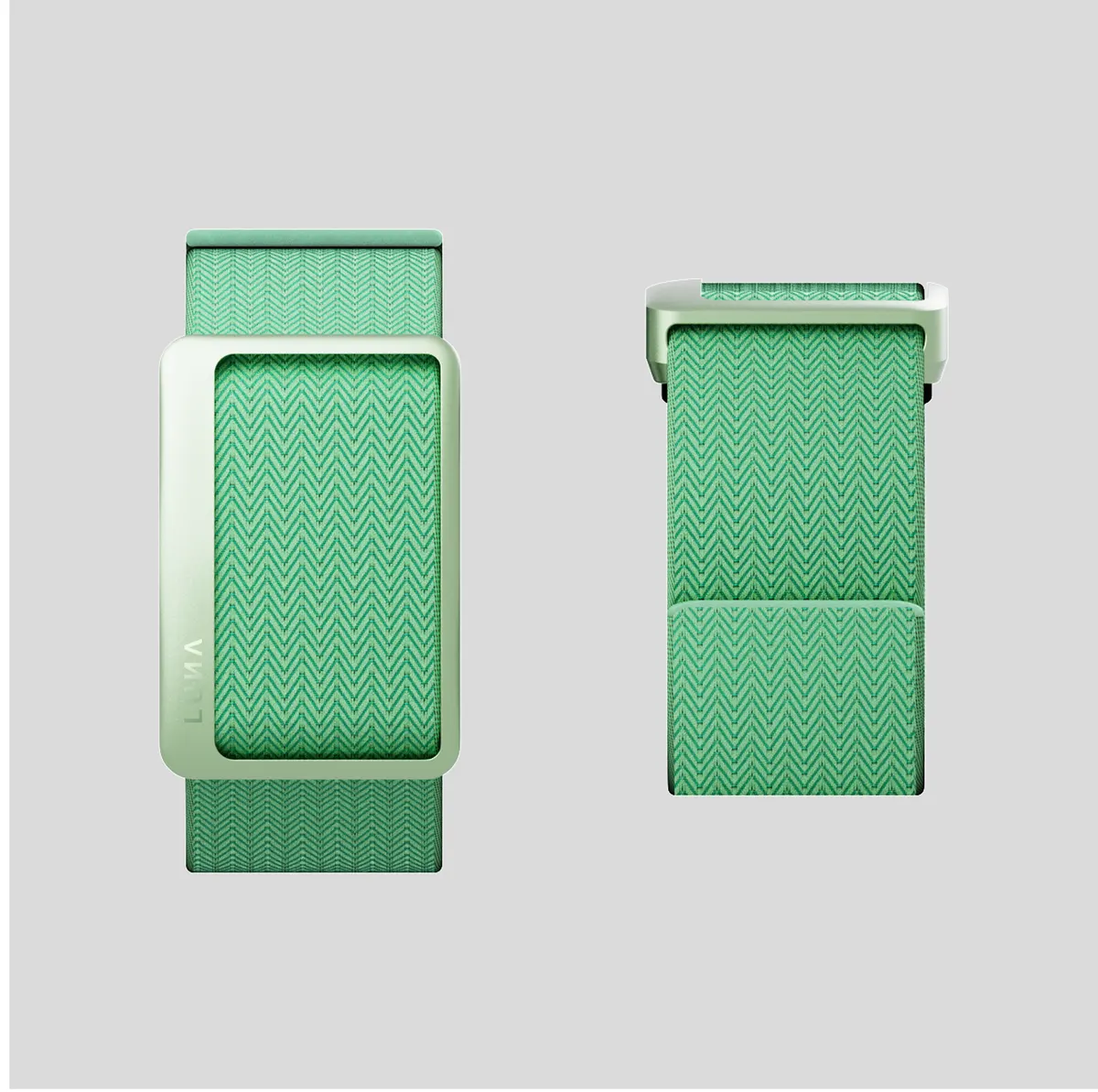
- Nylon hook-and-loop strap in Medium (240 mm) and Large (295 mm)Worn on the wrist or upper arm, either side; extra M-L strap in the box
- Weight
- 24 g module
- Charging
- About 60 minutes from empty, magnetic charger
- Battery
- Up to 10 days (typical)Luna's figure
- Water resistance
- 5 ATM
- Price
- $149 regular price (listing checked 2026-11-18, US, USD)Luna states a $119 promotion from 19 to 30 November 2026 only (Band only, worldwide, USD); confirm at checkout
- Subscription
- None requiredThe Luna app and LifeOS are free, including AI insights and coaching
- Colours
- Onyx Black, Aloe Green, Desert Beige
Who is the Luna Band for?
The Luna Band is for people who want a wearable that stays out of the way. It has no display. Alerts, nudges and alarms arrive as haptic vibration, and what you read about your day lives in the Luna app on your phone, on your schedule.
It is also for readers tired of paying a little every month to see their own numbers. Luna says the app and LifeOS are free for all users, including AI insights and coaching.
The verdict in one paragraph: if you want a screenless band, the Luna Band at $149 on the listing checked 2026-11-18 (regular price; Luna states a $119 promotion from 19 to 30 November 2026 only (Band only, worldwide, USD); confirm at checkout) is the option built around that brief. You pay once, charge roughly weekly, and open a free app with AI coaching when you choose. Its limits are plain: no built-in GPS, SpO2 and VO2 Max still listed as coming soon, and Luna's own pointer to its Ring for the most precise overnight tracking. In its favour, a selection of Luna Ring owners report problems getting fixed by support, covered below.
One note on wording. Luna's page describes haptic alerts and app-based metrics but never says "screenless" in so many words. The word is used because the page mentions no display.
What do the specs say about daytime and overnight wear?
This is a reading of the specifications, not a wear log. The module weighs 24 g and nothing on the band lights up, so a busy workday should involve fewer glances: nothing on your wrist invites you to check. Alerts still arrive as haptic vibration.
Luna lists PPG optical heart rate, a 3-axis accelerometer, a 3-axis gyroscope and skin temperature. From those it reports heart rate, HRV, skin temperature, training load, training effect, effort, heart rate zones and recovery. The band is rated 5 ATM.
Overnight, Luna lists sleep analysis for the Band and shares LifeOS with the Luna Ring, which it recommends for the most precise overnight tracking. Luna does not say how the Band's overnight accuracy compares, and no overnight wear test is documented, so how a night feels and how reliable the data is remain unknown. The Ring is the step up if sleep becomes your priority, and your data stays in the same app. If sleep is your main reason to buy, read Luna Band vs Google Fitbit Air and the sleep tracker guide first.
Which strap size and wearing position suit you?
The strap is nylon with a hook-and-loop closure, in Medium (240 mm) and Large (295 mm). It can be worn on the wrist or the upper arm, on either side. The upper arm is a documented option if you dislike anything on your wrist at a desk or want a different spot during workouts. According to Luna's product page, the box holds the band, a charger with USB cable and an extra M-L strap, and extra straps are sold separately in other colours.
Hook-and-loop straps adjust continuously, so in principle you can loosen it for a long day and snug it for a run. That is untested. Check your wrist measurement against the two sizes before you buy.
Colours are Onyx Black, Aloe Green and Desert Beige. Onyx Black is also sold on Amazon.com in the US, though Amazon's price and terms were not checked.
How often will you charge the Luna Band?
Luna says the battery lasts up to 10 days typical, and a magnetic charger takes about 60 minutes from empty. On those figures, charging is a weekly top-up rather than a nightly ritual. Pick a fixed daytime window, such as a Sunday morning at your desk, so charging never costs you a night of wear.
Ten days is a claim, not a result observed here. WHOOP states a longer 14+ days and Google states up to 7 days for Fitbit Air, so Luna sits in the middle on claimed figures. For a once-a-week routine, up to 10 days leaves days of slack.
What will you check in the Luna app?
The app is where the band's value shows up. You will see heart rate, HRV, skin temperature, recovery, training load, effort and heart rate zones, with 60+ workout modes. Walks, runs, cycling, elliptical and rowing are detected automatically, so you do not have to remember to press start.
There is no built-in GPS. Outdoor routes use the phone's GPS through the app, so you carry your phone on a run. Luna lists Apple Health, Google Health Connect and Clue as integrations, and the app runs on iOS and Android. SpO2 and VO2 Max are listed as coming soon, so do not buy for either today.
Luna publishes its own validation: 917 matched readings, a 0.987 Pearson correlation and a mean absolute error under 2, against a Polar reference. The page does not state the metric or units beside those figures, and the results have not been reproduced by third parties, so treat them as a manufacturer claim.
What do Luna owners say about support and the app?
Here is what a selection of five-star Trustpilot reviews of Luna says. Nine were read from screenshots on 2026-11-18. The publisher picked them, so they are not Luna's overall rating and not typical of all customers, and some were invited reviews. They come from Luna Ring owners and people using the Luna app and LifeOS, not from Luna Band owners. They are used here only as evidence about support, delivery handling, the app and the no-subscription model. They say nothing about Band hardware, comfort, accuracy or battery.
- Support after a hiccup. A US reviewer (July 2026) had a sleep-logging problem in the Luna app, said support fixed it quickly and reported no issue since. An Australian reviewer (March 2026) had a faulty first ring and said the Australian team reached out and fixed it quickly. A reviewer in Poland (February 2026, invited) said Luna reacted quickly to battery trouble and sent a new ring.
- Delivery handling. A reviewer in the UAE (March 2026) described a delivery delay and said support replied quickly and made sure the ring arrived safely. A German reviewer (February 2026, invited) said a package was lost, the helpdesk searched for it and sent a second one, and that emails were always answered.
- The app and the coaching. An Indian reviewer (June 2026) said they enjoy the AI guidance in LifeOS and can now understand their data and what to do with it. Another Indian reviewer (February 2026, invited) described Luna Ring Gen 2 as tracking the key health metrics with commendable accuracy and helping plan workouts, stress and sleep. A Spanish reviewer (February 2026, invited) said the ring met expectations, the information is useful and customer care was good.
- No ongoing subscription. The Australian reviewer also liked the design and features and that no ongoing subscription is required.
Read this fairly. Six of the nine describe a problem first: a logging bug, a faulty ring, a delay, a lost parcel or a draining battery. What they praise is how it was handled, which is the useful signal for a small brand. One Singapore reviewer (February 2026) says as much, noting that a small team can mean slower replies, while describing the team taking ownership when the ring battery depleted fast and resolving it. Expect friendly help, but not instant help every time.
On paper, Luna's refund policy page (read 2026-11-18) says the Ring and the Band can be returned within 14 days of delivery. It lists a 12-month limited warranty on the Band, support by email at support@lunazone.com and through a support form, and shipping aimed within 2 business days. Check the terms for your region before you order.
What does the Luna Band cost upfront and over time?
The price is $149, and there is no required subscription per current terms, so it is also $149 after 12 months and after 24. WHOOP 5.0 with a One membership is listed at $199 per year with the band included: $50 more at 12 months and $249 more at 24 if you renew at the listed price. Fitbit Air is $49 cheaper at purchase at $99.99, before Google Health Premium, which is optional at $9.99 per month. WHOOP lists monthly billing only after a 12-month commitment and states no monthly price, and Google lists no annual Premium price. See Luna Band vs WHOOP 5.0 for the longer cost picture.
Who should buy the Luna Band, and who should look elsewhere?
Choose the Luna Band if:
- You want a screenless band and a low-attention routine.
- You want no required subscription, with AI coaching in a free app.
- You want roughly weekly charging.
- You prefer haptic alarms to an on-wrist display for messages.
- You want a strap you can wear on the wrist or upper arm.
- You want a brand with a published 14-day return window and, per a selection of Ring-owner reviews, support that fixed problems.
- You mostly care about daytime activity, training load and recovery.
Look elsewhere if:
- You want a display or built-in GPS. A smartwatch, or Fitbit Edge, a Fitbit tracker with a display, GPS and an altimeter from $179.99, fits better.
- You want WHOOP's 14+ day battery claim or ECG and blood pressure insights (wellness features) on the WHOOP MG band.
- You want the lowest purchase price: Google Fitbit Air at $99.99.
- You want SpO2 or VO2 Max today, or the most precise overnight tracking.
Wellness devices are not medical devices, and the Luna Band is for adults aged 18 and over.
Sources
- Luna Band product page, LunazoneRead November 18, 2026
- WHOOP membership pageRead November 18, 2026
- WHOOP support: Membership pricingRead November 18, 2026
- Google Store: Google Fitbit AirRead November 18, 2026
- Google Store: watches and trackersRead November 18, 2026
- Google Store: Google Health PremiumRead November 18, 2026
- Luna refund policy, LunazoneRead November 18, 2026