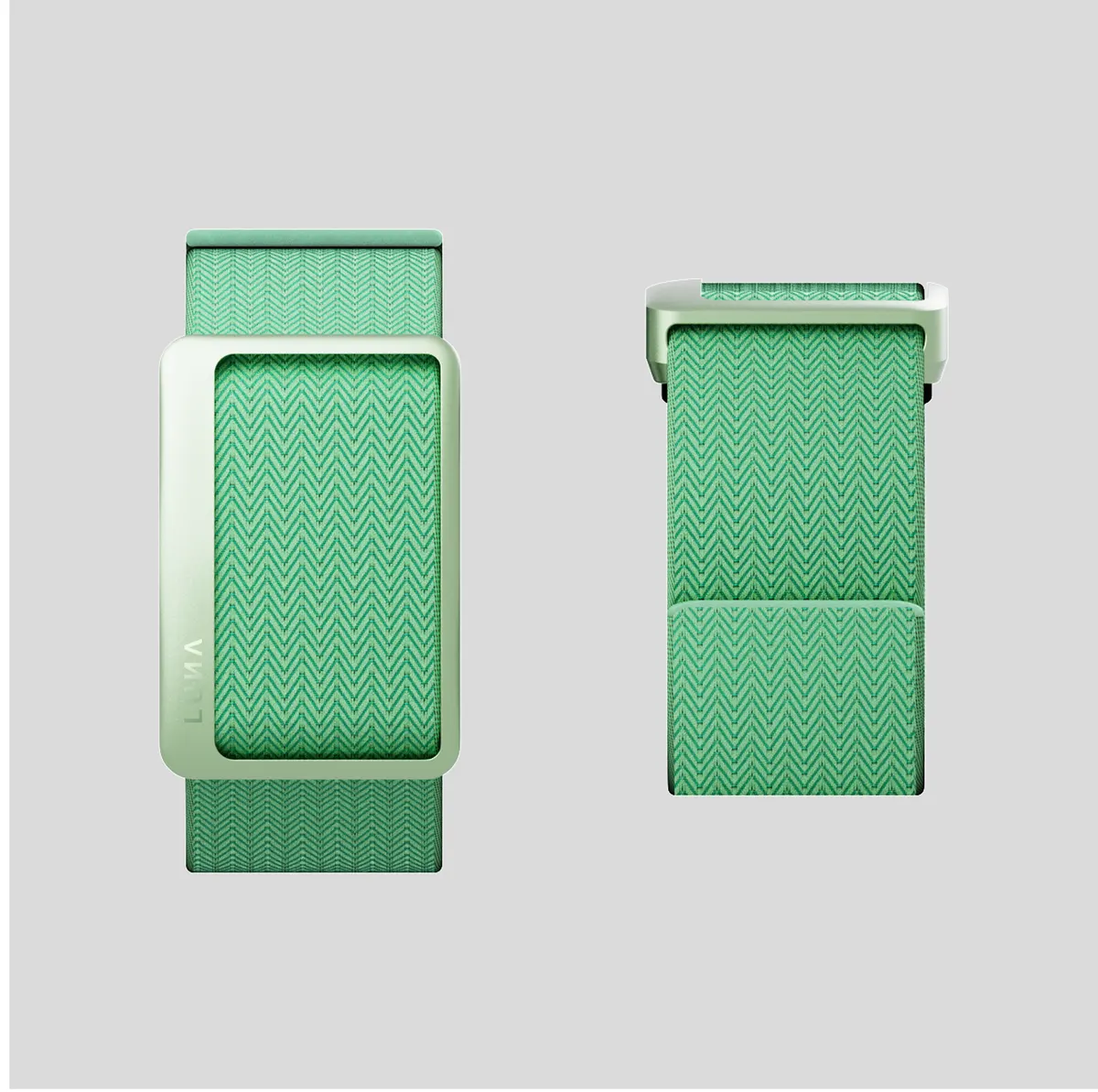
The band you forget is the band you keep wearing, and for most routines Luna Band is built for that. It has no display, nothing to glance at, and a claimed up to 10 days of battery that turns charging into a once-a-week habit. WHOOP claims 14+ days, which is longer, and Google says up to 7 days for Fitbit Air. All three are manufacturer claims, and no battery tests were run. What is worth thinking about is what those days mean for a life where you want to forget you are wearing a band.
What does claimed battery life change about a routine?
A band you charge every night is a band you take off every night. A band you charge once a week fits into a Sunday habit and can stay on your arm through the week. That is the case for Luna's up to 10 days: roughly weekly charging, with days of slack if you forget. Seven days leaves less margin, and 14 days is a fortnightly rhythm that matters mainly if you travel.
Why does a weekly charging habit suit Luna Band?
If the claim holds, up to 10 days is plenty for most weekly routines. Charge the Luna Band on a Sunday morning at your desk, and you have days of slack in case you forget. Luna says the magnetic charger takes about 60 minutes from empty, which keeps the habit short enough to fit around a shower or breakfast.
The rest of the band supports forgetting it. Luna has no display, so nothing lights up to pull you into your phone. The module is 24 g on a nylon hook-and-loop strap in Medium (240 mm) or Large (295 mm), worn on the wrist or upper arm, and the box includes an extra M-L strap. Haptic alerts replace a screen, and the band is rated 5 ATM.
Fitbit Air's up to 7 days claim leaves less slack, so it suits a fixed charging day best. Whatever the band, tie charging to an anchor such as Sunday evening or the morning you pack.
Which claim suits a long trip?
WHOOP, if the claim holds. A 14+ day claim means a two-week trip without a charger, which is a real advantage. WHOOP also lists a Wireless PowerPack that gives 4+ days per charge, a different route to the same goal that Luna Band vs WHOOP 5.0 puts in context.
For a long weekend or a one-week trip, Luna's 10-day claim should be enough. Start the trip with a full charge, and pack the charger for anything longer.
Does battery outweigh cost, fit and attention?
Battery is one part of forgetting a band, and Luna does well on the others:
- Cost. Luna Band is $149 on the listing checked 2026-11-18 (regular price; Luna states a $119 promotion from 19 to 30 November 2026 only (Band only, worldwide, USD); confirm at checkout), once. WHOOP 5.0 with One is $199 per year, so $398 over 24 months if you renew at the listed price. Fitbit Air is $99.99, which is $49 less at purchase, and its coaching sits in optional Google Health Premium at $9.99 per month.
- Fit. Luna is a 24 g module on a strap you can wear on the wrist or upper arm. WHOOP's and Google's pages do not state strap or weight details.
- Attention. All three are screenless. Luna delivers alerts and alarms by haptic vibration, and its app and LifeOS are free, including AI insights and coaching.
Longer battery may also tempt you to leave the band on overnight. Luna lists sleep analysis for the Band, and it recommends its Ring for the most precise overnight tracking. For more on this, see the sleep tracker guide.
Which battery claim should win your wrist?
Luna Band suits most readers: a weekly charging habit, a quiet wrist and no subscription. See the Luna Band review.
WHOOP 5.0 (One membership) if the 14+ day claim is the deciding factor and you are comfortable with a yearly membership.
Google Fitbit Air if the lowest purchase price comes first and a weekly charge is acceptable.
Battery claims change, and the figures were checked on 2026-11-18. Wellness devices are not medical devices.
Sources
- Luna Band product page, LunazoneRead November 18, 2026
- WHOOP membership pageRead November 18, 2026
- WHOOP support: Membership pricingRead November 18, 2026
- WHOOP support: WHOOP basicsRead November 18, 2026
- Google Store: Google Fitbit AirRead November 18, 2026
- Google Store: Google Health PremiumRead November 18, 2026